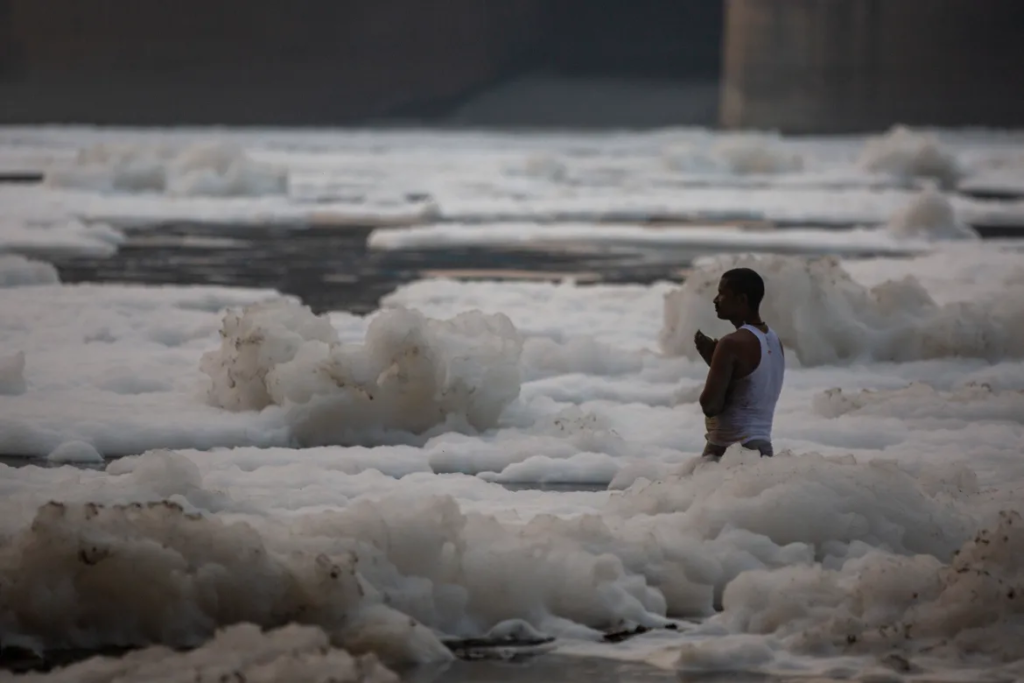

Foam on the Yamuna near Delhi’s Kalindi Kunj is associated with foaming agents in wastewater and agitation as water falls from the Okhla barrage. An official parliamentary answer dated 9 February 2026 identifies detergent surfactants in untreated or partly treated sewage as major foaming agents. Describing the problem only as industrial pollution misses part of the documented explanation.
Why does foam form near the barrage?
The Ministry of Jal Shakti’s answer describes CPCB monitoring conducted during 2022–2024. It explains that the sudden fall of water agitates foaming agents already present in wastewater, producing foam on the surface. The monitoring period is historical; it is not a water-quality reading for today.
How do sewage and industrial effluent contribute?
The February 2026 answer lists untreated or partially treated sewage, missing common effluent treatment plants in some approved industrial areas, and delays in sewage-treatment projects among the causes of pollution in Delhi’s Yamuna stretch.
A separate CPCB announcement, published through the Press Information Bureau on 6 December 2020, linked earlier frothing episodes to untreated sewage and inadequate operation of sewage and industrial-effluent treatment facilities. It also noted phosphorus-containing discharges. These records support examining both domestic wastewater and industrial treatment.
What have authorities said about action?
The 2020 announcement recorded directions to Delhi Jal Board on sewage-treatment compliance and preventing untreated discharges. It also described directions to pollution-control authorities concerning non-compliant industrial units and common treatment plants. Those directions document action requested at that time, rather than proof that the river is now clean.
How to assess claims about the river today
A photograph can document visible foam at a particular place and time. By itself, it cannot establish a pollutant concentration, identify a responsible factory or measure the success of a cleanup programme. A current assessment needs dated sampling results and a clearly identified monitoring location.
- Check the sample date as well as the report’s publication date.
- Distinguish a river sample from a drain or treatment-plant sample.
- Check whether a figure describes installed capacity, actual treatment or measured discharge.
- Keep claims about health effects separate from observations of visible foam.
Official sources
- Rajya Sabha question 1047: Pollution in Yamuna Ghat, answered 9 February 2026.
- CPCB announcement on pollution and frothing, 6 December 2020.
Another city-data explainer: how to compare Hyderabad and Delhi living costs using like-for-like information.
Updated 27 September 2026 with official source dates and a clearer distinction between foam formation and current water-quality measurements.