
India AI Impact Summit 2026: Modi’s MANAV Vision and Ethical AI Proposals
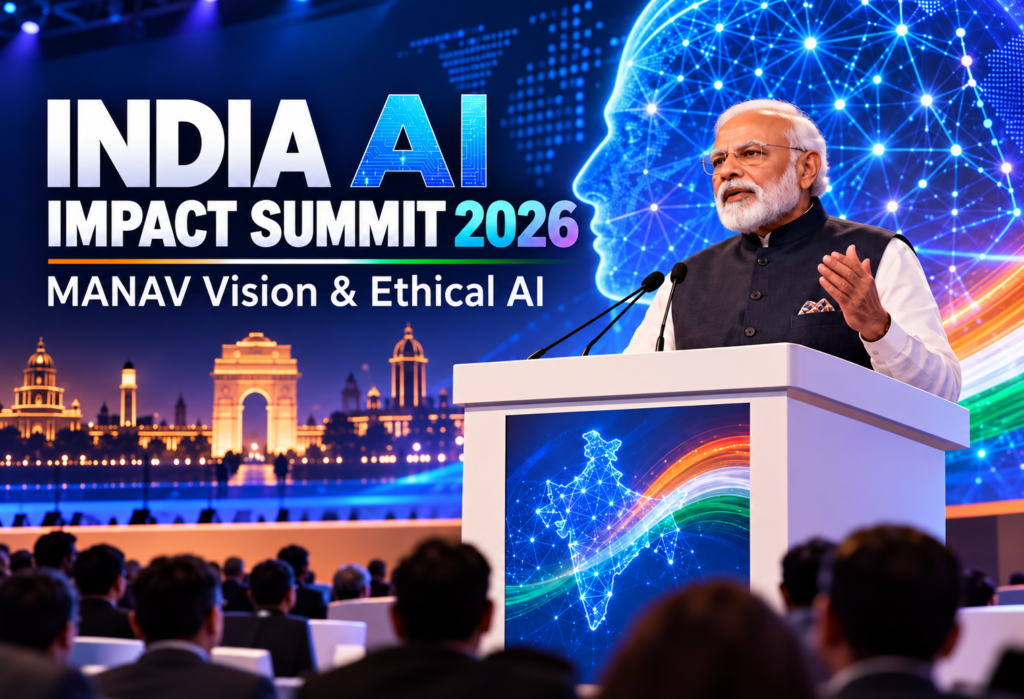
The India AI Impact Summit 2026 brought global attention to responsible artificial intelligence as Prime Minister Narendra Modi introduced the MANAV Vision on February 19, 2026, at Bharat Mandapam in New Delhi.
The framework focuses on ethical systems, accountability, national sovereignty, accessibility and legitimacy. Modi also presented three proposals aimed at improving trust and transparency in AI development.
The summit brought together policymakers, researchers and technology leaders to discuss the future of artificial intelligence. Its central theme was Sarvajan Hitaya, Sarvajan Sukhaya, meaning welfare for all and happiness for all.
India AI Impact Summit 2026: Key Highlights
| Summit Detail | Information |
|---|---|
| Event | India AI Impact Summit 2026 |
| Dates | February 16–20, 2026 |
| Location | Bharat Mandapam, New Delhi |
| Key address | February 19, 2026 |
| Speaker | Prime Minister Narendra Modi |
| Main AI framework | MANAV Vision |
| Summit pillars | People, Planet and Progress |
| Main focus | Ethical, inclusive and human-centric AI |
According to the official Prime Minister’s Office announcement, the event explored the opportunities and responsibilities associated with rapidly developing AI technologies.
The discussions also addressed how developing countries could participate meaningfully in international AI governance.
What Is Modi’s MANAV Vision for AI?
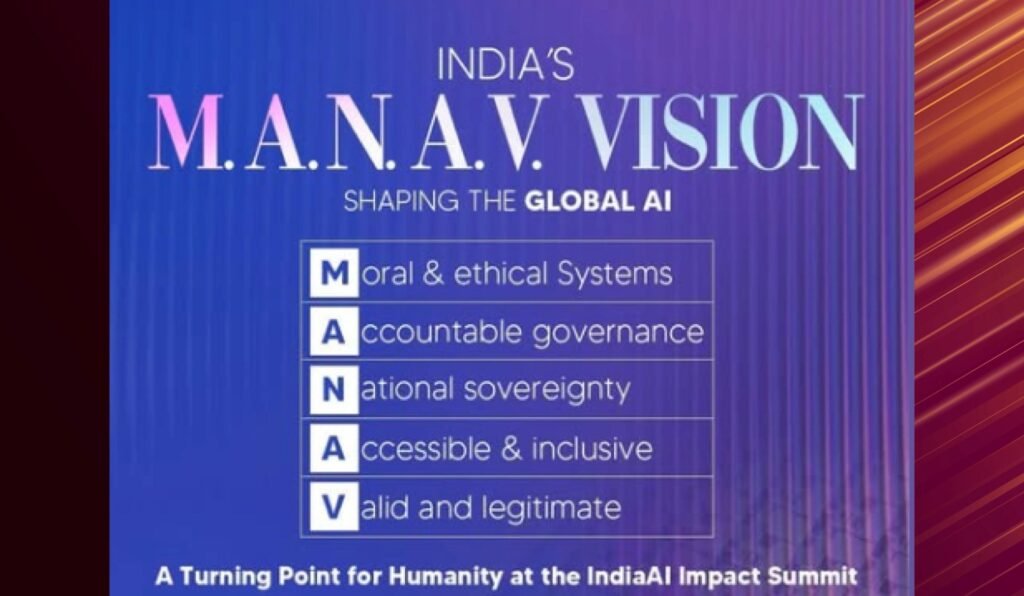
The MANAV Vision, introduced during the India AI Impact Summit 2026, is a five-part framework explaining India’s proposed principles for human-centered AI.
MANAV means human in Hindi, emphasizing the importance of keeping people involved in technological decisions.
Five Principles of the MANAV Vision
| Letter | Principle | Main Objective |
|---|---|---|
| M | Moral and Ethical Systems | Develop AI according to ethical guidelines |
| A | Accountable Governance | Establish transparency and effective oversight |
| N | National Sovereignty | Respect data ownership and sovereignty |
| A | Accessible and Inclusive | Make AI available beyond a limited number of organizations |
| V | Valid and Legitimate | Ensure AI is lawful and verifiable |
These principles describe how AI could serve society while reducing risks related to irresponsible development and unequal access.
The framework is a statement of policy direction, rather than evidence that all five principles have already been implemented across India’s AI sector.
Three Ethical AI Proposals Presented by Modi
During a separate leaders’ plenary session, Modi outlined three proposals addressing trust, safety and human responsibility.
1. Trusted Global Data Framework
Modi called for an international framework that respects data sovereignty and encourages reliable training data.
The proposal emphasizes that AI systems depend on the quality, balance and security of the information used during development.
It also raises questions about data protection, ownership and cooperation between countries.
2. Transparent AI Safety Rules
The second proposal promotes a transparent approach to AI safety.
Modi described the importance of a glass-box approach, in which safety rules can be examined and verified, rather than remaining hidden from scrutiny.
Greater transparency could help regulators, independent researchers and users understand whether a system follows its stated safeguards.
3. Human Values in AI Development
The third proposal calls for AI systems to reflect human values and priorities.
Modi referred to the theoretical paperclip problem, illustrating how a system pursuing a narrowly defined objective could cause unintended harm.
The proposal emphasizes human direction and oversight, especially when AI technologies influence important decisions.
These three points are documented in the official leaders’ plenary summary.
Why Ethical AI Matters for India
The India AI Impact Summit 2026 highlighted several challenges that governments and technology companies face when deploying AI.
| Challenge | Potential Response |
|---|---|
| Deepfakes and fabricated content | Content authenticity labels and watermarking |
| Data misuse | Privacy safeguards and responsible data governance |
| Limited AI access | Affordable computing and multilingual services |
| Unclear AI decisions | Transparent safeguards and accountability |
| Risks to children | Child-focused safety protections |
| Workforce disruption | Training, reskilling and digital education |
Modi emphasized the importance of recognizing synthetic content and protecting children from inappropriate AI-related risks.
These proposals could influence future discussions about digital safety, although their effectiveness would depend on implementation and independent evaluation.
India’s AI Mission and Technology Development
The summit also connected ethical AI with India’s wider technological ambitions.
In his February 19 plenary remarks, Modi stated that 38,000 GPUs were already available through India’s AI Mission and that another 24,000 would be added over the following six months.
He also stated that AIKosh, India’s national dataset platform, contained more than 7,500 datasets and 270 AI models.
These were government-reported figures at the time of the address, not independently verified October 2026 totals.
India’s broader AI development includes efforts involving local-language technology, computing infrastructure, startups and research.
For more background, read our Sarvam AI explainer, which examines an Indian AI company focused on building domestic capabilities.
International Cooperation and AI Governance
International cooperation was another important subject at the India AI Impact Summit 2026.
The summit’s People, Planet and Progress pillars connected AI development with social inclusion, environmental concerns and economic opportunities.
Modi argued that developing countries should have a meaningful role in AI governance instead of relying entirely on decisions made by a small number of technology companies or governments.
International discussions also took place alongside wider diplomatic engagements. Readers can explore related coverage of the Modi–Macron Mumbai meeting in 2026.
How Can MANAV Vision Implementation Be Measured?
A framework becomes more meaningful when its principles can be connected to measurable outcomes.
Possible indicators include published AI safety standards, clearer data-governance procedures, accessible AI services in regional languages, independent evaluations and documented protections for affected users.
Governments and companies would also need to explain who is responsible when AI systems cause harm or produce unreliable decisions.
The MANAV Vision outlines aspirations for responsible artificial intelligence. Assessing progress requires evidence beyond summit speeches or announcements.
Frequently Asked Questions
What is the India AI Impact Summit 2026?
The India AI Impact Summit 2026 was an international gathering in New Delhi, held from February 16 to 20, focused on artificial intelligence, governance, inclusion and technological development.
What does MANAV stand for in AI?
MANAV represents Moral and Ethical Systems, Accountable Governance, National Sovereignty, Accessible and Inclusive, and Valid and Legitimate.
When did Narendra Modi introduce the MANAV Vision?
Prime Minister Narendra Modi introduced the MANAV Vision during his inaugural address on February 19, 2026, at Bharat Mandapam in New Delhi.
What were Modi’s three ethical AI proposals?
The proposals covered a trusted global data framework, transparent AI safety rules and embedding human values in AI systems.
Is the MANAV Vision an AI law?
No. The MANAV Vision is a policy framework presented at the summit. Its introduction does not itself establish a binding law or prove that every proposal has been implemented.
Conclusion
The India AI Impact Summit 2026 placed human-centered artificial intelligence at the center of international policy discussions.
Modi’s MANAV Vision and three ethical AI proposals emphasized accountability, trustworthy data, wider access and human oversight.
The next measure of progress is whether these ideas translate into clear standards, practical protections and accessible technologies that can be independently evaluated.