

A morning assembly news report should give students a few clear, verified updates that are easy to follow when read aloud. Start with the date, present your selected headlines in a consistent order, and close with a brief thank-you.
This guide provides a reusable format and an editable English script. It is not a bulletin of today’s headlines. Replace every bracketed field with information checked for your assembly date.
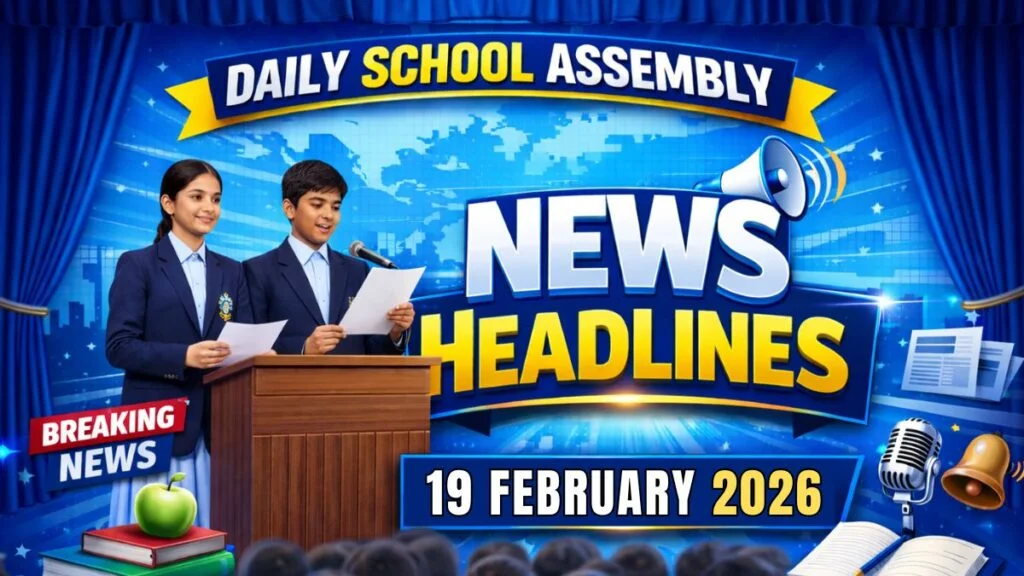
A simple school assembly news format
For a short slot, choose four or five items and rehearse them against the time your teacher has assigned. The order below is a suggested structure, not a rule every school must follow.
- Greeting and date: introduce yourself and state the full date.
- National or local news: give one relevant, verified update.
- World news: explain one international development in plain language.
- Sports: name the teams or athlete, competition, date and result.
- School or education news: use an approved school notice or an official education announcement.
- Weather and closing: add a local forecast if needed, then thank the audience.
Editable morning assembly script in English
Template only: the fields below are placeholders, not reported news.
Good morning, respected principal, teachers and fellow students. I am [name] from [class]. Here are the news headlines for [day, date, month and year].
First, national news. [Organisation or person] has [verified action] in [place]. [One short sentence explaining the main detail.]
In world news, [verified event and location]. [One sentence explaining why it matters.]
In sports, [team or athlete] [result] in [competition] on [match date].
For our school, [approved announcement, date and any action students need to take].
The forecast for [town or city] on [date] is [verified conditions], according to [weather service and issue time].
Those were the headlines. Thank you, and have a good day.
How to turn a news story into a short headline
Write the main event first: who did what, where and when. Add a second sentence only if it helps the audience understand the result. Replace unfamiliar abbreviations with their full names and remove promotional language.
A useful sports pattern is: “[Team A] beat [Team B] by [margin] in [competition] on [date].” Check the final score before filling it in. A preview or prediction cannot establish who won.
For practice with dated results, use our SRH vs Rajasthan Royals match timeline. Its historical matches are examples for summarising; do not present them as today’s results.
Check these details before reading aloud
- Event date: distinguish when something happened from when the article was published.
- Source: keep the original report or official notice beside your draft. A search-results headline alone may omit context.
- Names and numbers: check spelling, pronunciation, scores and units.
- Status: separate a proposal, an announcement and a completed action.
- Local relevance: confirm that school notices and weather forecasts apply to your location.
- Teacher review: ask a teacher to review sensitive or difficult topics and the final script.
Weather updates need a place and a date
A statement such as “some areas may receive rain” is not useful for a particular school. Use a forecast for your town or city, check its issue time, and refresh it before the assembly. If you cannot verify the forecast, leave that segment out.
Optional thought of the day
You can finish with an original reminder: “Check the facts, speak clearly, and keep learning.” If you prefer a quotation from someone else, verify the wording and attribution before naming the speaker.
Frequently asked questions
How many headlines should I read?
Follow your school’s time limit. Four or five concise items are a practical starting point; rehearse and shorten them if necessary.
Can I use this script on any date?
Yes. Replace the date, stories, school notice and forecast every time. Do not leave placeholders in the final version.
Does this page contain the February 19 news?
No. An earlier version used a February 19 edition label without providing specific sourced headlines. It has been replaced with this clearly labelled preparation guide.
Morning assembly news report: ready-to-customise short example
The following example is a practice script, not a report of verified current events. Replace each placeholder before reading it at school.
Good morning, respected principal, teachers and my dear friends. I am [student name] from [class]. Today is [weekday, full date]. Here are our morning assembly news headlines.
National news: [One confirmed development in your country, with its date].
International news: [One verified global headline and its location].
Sports news: [Competition, teams, completed result and match date].
School announcement: [Teacher-approved notice, deadline or event].
These are our news headlines for today. Thank you, and have a wonderful day.
Helpful checklist for a confident delivery
- Write the date at the top and say it aloud during rehearsal.
- Use short sentences so younger students can follow each update.
- Check names, match results and locations with reliable original sources.
- Mark unfamiliar words and practise them before speaking.
- Avoid using unverified breaking news or social media rumours.
- Remove every bracketed placeholder before the final reading.
Important: This evergreen morning assembly news report template is designed to help students prepare a bulletin. It does not claim to provide today’s news or a real-time forecast.